
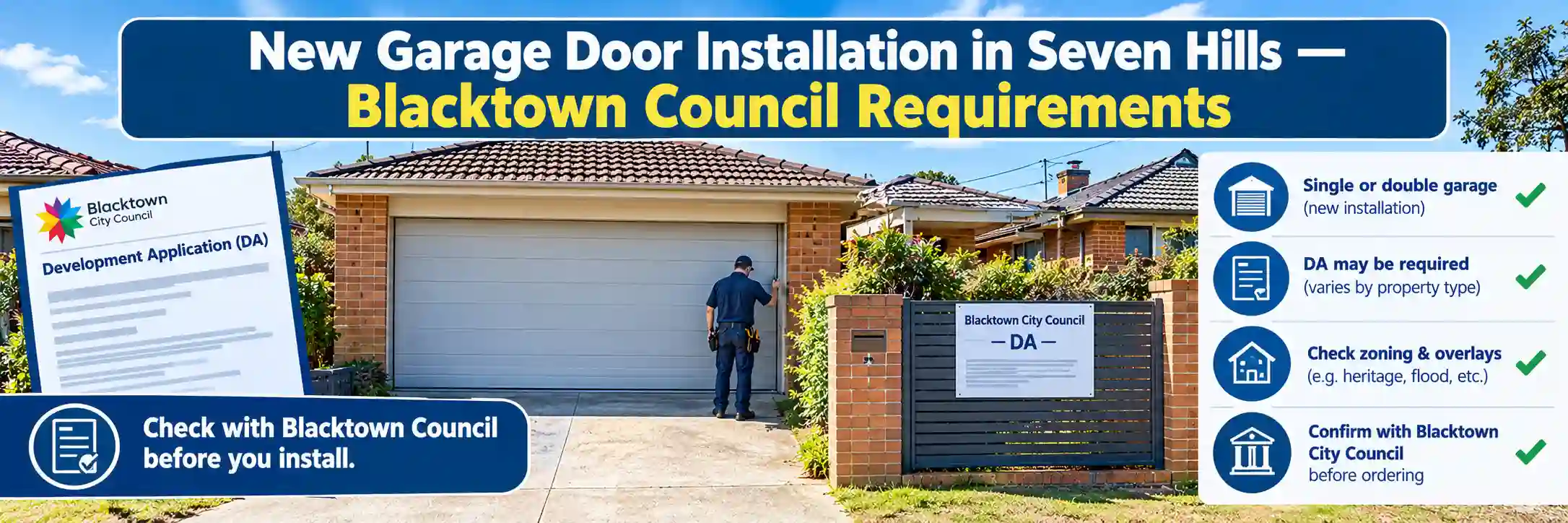
New garage door installation in Seven Hills involves the City of Blacktown’s planning framework — the Blacktown Local Environmental Plan 2015 and the NSW State Environmental Planning Policy (Exempt and Complying Development Codes) 2008 that together govern what development works require approval and what can proceed without a development application. Blacktown City Council is the largest local government area in New South Wales by population, serving over 400,000 residents across 47 suburbs, and the planning framework it administers under the Blacktown LEP 2015 reflects the wide range of residential and commercial development across this large and diverse western Sydney municipality.
For Seven Hills homeowners replacing an existing garage door or installing a new one as part of a renovation or dual occupancy development, understanding the specific requirements of the Blacktown LEP 2015 and the SEPP Codes is the practical knowledge that ensures the installation proceeds correctly from the start.
Blacktown LEP 2015 and SEPP exempt development for Seven Hills
New garage door installation in Seven Hills under the Blacktown Local Environmental Plan 2015 and the SEPP (Exempt and Complying Development Codes) 2008 follows the NSW exempt development pathway for most standard residential replacement installations:
A like-for-like replacement of an existing garage door in an existing opening on a residential property in Seven Hills’ R2 Low Density Residential zone — the dominant residential zone across Seven Hills’ established housing streets — is generally assessable as exempt development, proceeding without a development application to Blacktown City Council, provided:
- The property is not listed as a heritage item in the Blacktown LEP 2015 Schedule 5 or within a heritage conservation area.
- The proposed installation does not involve structural modification to the garage opening — no widening, raising, or changing the opening dimensions.
- The proposed door is consistent with the character of the dwelling and the streetscape.
For Seven Hills, the practical application of these criteria is straightforward for most established homes. The suburb’s housing stock does not carry the heritage complexity of inner Melbourne or the conservation area provisions of Sydney’s established north shore suburbs. Most Seven Hills garage door replacements on standard residential lots proceed as exempt development without council interaction.
Garage and secondary dwelling DA activity in Seven Hills
New garage door installation in Seven Hills has a specific dimension that the Blacktown City Council DA records for Seven Hills make visible: the suburb has consistent DA activity for garage additions, carport-to-garage conversions, demolition of existing garages and replacement with new structures, and dual occupancy and secondary dwelling additions that include garages. This pattern of active garage-related development in Seven Hills means that a meaningful proportion of new garage door installations in the suburb are part of a larger development project that has its own DA conditions from Blacktown City Council.
For Seven Hills homeowners whose garage door installation is part of a DA-approved project — a dual occupancy addition, a secondary dwelling, or a new garage structure replacing an old one — the development consent conditions should be reviewed before any door product is ordered. The DA conditions for garage construction or alteration may specify:
- The garage opening width and height dimensions that the development consent approved.
- Requirements for the garage door to be consistent with the dwelling’s facade character.
- Set-back requirements for the garage structure from the street boundary that determine the available space for the door’s operational clearance.
- Any conditions relating to vehicle access width that affect the permissible door width.
Western Sydney heat specification for Seven Hills installations
New garage door installation in Seven Hills requires a product specification appropriate for western Sydney’s summer heat. The specification principles that apply in Penrith at its extreme level also apply in Seven Hills at a moderate western Sydney level:
- Colorbond colour selection — for west or north-west-facing garage doors in Seven Hills that receive direct afternoon sun, a pale Colorbond colour — Surfmist, Classic Cream, Shale Grey — reduces the solar heat gain through the door panel compared with darker tones. Seven Hills’ afternoon sun does not reach the extreme intensity of Penrith’s Blue Mountains heat trap, but the western Sydney inland position still makes pale colour selection a meaningful thermal decision for afternoon sun-exposed doors.
- IP55+ motor specification — the opener motor for any Seven Hills installation should carry an IP55 or higher housing rating for western Sydney’s summer temperatures and the dust events that western Sydney experiences in dry summer conditions.
- Insulated panels for attached garages — for Seven Hills attached garages sharing a wall with a living area, an insulated sectional panel reduces the heat transfer through the shared wall during the western Sydney summer, contributing to the adjacent room’s comfort and reducing air conditioning load on the hottest days.
- EPDM bottom seal — western Sydney’s UV intensity degrades standard rubber seals faster than in coastal Sydney environments. An EPDM rubber bottom seal maintains its flexibility longer under western Sydney’s UV and temperature cycling.
Dual occupancy installation considerations in Seven Hills
New garage door installation in Seven Hills for the dual occupancy and secondary dwelling developments that are active in the suburb follows the same planning pathway described in the Auburn dual occupancy blog — the most directly relevant guide in this series. The SEPP (Housing) 2021 secondary dwelling pathway, the development consent conditions for full dual occupancy DAs to Blacktown City Council, and the strata and body corporate framework for multi-unit developments all apply in Seven Hills as they do across NSW.
For Seven Hills dual occupancy installations specifically, the design consideration of matching doors on side-by-side garages — as the Auburn blog describes — applies equally here, and separate automation credentials for each dwelling’s garage are the security standard that maintains the access boundary between two households sharing a lot.
Installing above existing carports in Seven Hills
New garage door installation in Seven Hills has one specific dimension that is unusually visible in the Blacktown Council DA records: the carport-to-garage conversion. Seven Hills has multiple recorded applications for the demolition of existing carports and the construction of enclosed garages in their place, and for the modification of existing open carport structures to incorporate a garage door. A carport-to-garage conversion that involves installing a garage door in an opening that has never had one is not a like-for-like replacement — it is a new installation in a previously open structure, and it requires a DA to Blacktown City Council if the carport structure itself is within a heritage conservation area or if the structural modification of adding the door frame and jambs constitutes building works that are not exempt under the SEPP Codes.
For Seven Hills homeowners converting a carport to a garage, confirming the planning pathway with a Blacktown City Council duty planner before any work commences is the brief enquiry that determines whether the conversion is exempt development or requires a development application.
The broader context of Blacktown City Council’s planning framework is worth noting for Seven Hills homeowners who are undertaking new garage door installations as part of larger renovation projects. Blacktown City Council’s Development Control Plan, which supplements the Blacktown LEP 2015, includes design guidelines for residential developments that address the visual impact of garages on street character.
These guidelines reflect the Council’s ongoing work to improve the built environment quality of western Sydney’s established suburban streets — including Seven Hills’ residential precincts — as part of the broader investment in the Blacktown LGA’s liveability and amenity. A new garage door installation that takes account of these design guidelines — selecting a profile and colour that relates to the home’s facade rather than introducing a starkly contrasting element — is one that contributes positively to Seven Hills’ streetscape quality alongside meeting the homeowner’s functional needs.
Blacktown City Council’s proactive planning approach to the Blacktown LGA — including the investment in urban renewal, transport-oriented development near stations, and quality residential streetscapes — creates a planning environment in which new garage door installations are part of a broader suburban improvement picture. A Seven Hills homeowner who replaces a weathered original tilt door from the 1960s with a quality new roller or sectional door in a colour that complements their home’s brick facade is contributing to the incremental improvement of Seven Hills’ streetscape quality that the Council’s planning framework is designed to support.
The planning process that confirms the installation is exempt development is brief; the visual improvement to the street that a quality new door delivers compared with a 60-year-old faded original is lasting. The new installation decision is therefore both a planning compliance action and a neighbourhood quality investment that Seven Hills’ improving residential environment increasingly rewards.
Conclusion
New garage door installation in Seven Hills involves the Blacktown Local Environmental Plan 2015 and the NSW SEPP Codes exempt development provisions for standard residential replacements, specific DA-condition review requirements for dual occupancy and secondary dwelling project installations, the carport-to-garage conversion planning pathway, and a western Sydney heat specification using pale Colorbond colours, IP55+ motors, and EPDM seals.
A western Sydney installer who understands the Blacktown LEP framework, who knows the suburb’s active dual occupancy and carport conversion development pattern, and who specifies correctly for Seven Hills’ summer heat delivers an installation that is compliant, heat-appropriate, and built to last in western Sydney’s demanding residential environment.