Garage door motor replacement in Seven Hills is the predictable service need for the suburb’s ageing housing stock whose automatic garage door openers were installed in the renovation wave of the late 1980s and 1990s. Seven Hills’ residential streets were built predominantly between the late 1950s and the 1970s, and the homes that were upgraded with automatic openers in the decade and a half following the widespread adoption of residential garage door automation — from approximately 1985 through to the late 1990s — now have motors that are 25 to 35 years old.
These chain-driven AC motors have worn drive gears, heat-degraded circuit boards from 25 to 30 western Sydney summers, and motor windings that have been through the full thermal cycling range of Sydney’s western inland climate. Garage door motor replacement in Seven Hills converts these noisy, slow, or failing original motors into quiet, smart-connected, IP-rated openers whose daily performance matches the expectations of a 21st century Blacktown family household.
Signs a Seven Hills motor needs replacement
Garage door motor replacement in Seven Hills: the warning signs of a motor approaching end of service life in a western Sydney family home:
- Increased noise on hot afternoons — a motor whose circuit board has marginal connections from heat cycling may produce worse noise performance on the hottest western Sydney afternoons when its electronics are at their thermal limit. The motor that operates at an acceptable noise level in winter may produce grinding, stuttering, or erratic sounds on a 38-degree January afternoon — signalling that the board’s connections are failing under thermal stress.
- Thermal cutout activation — if the opener motor regularly trips its thermal protection on hot afternoons and then resumes operation after cooling, the motor is regularly operating at or above its thermal design limit. Repeated thermal protection activation degrades the circuit board faster and signals that the motor’s thermal headroom has been consumed by 25 or 30 years of western Sydney summer operation.
- Drive gear slipping — the plastic or nylon drive gears in ageing chain-driven motors wear to the point where the motor runs but the door moves slowly or not at all. The distinctive sound of a running motor with no door movement is the gear strip signature that identifies this failure mode.
- Remote range reduction — a motor whose receiver antenna or circuit has been moisture-affected by decades of western Sydney humidity cycling may have reduced effective remote range, requiring the vehicle to be close to or inside the driveway before the door responds.
Motor type selection for Seven Hills family homes
Garage door motor replacement in Seven Hills for the suburb’s typical brick veneer family home involves motor type selection appropriate for the western Sydney environment and the family household usage pattern:
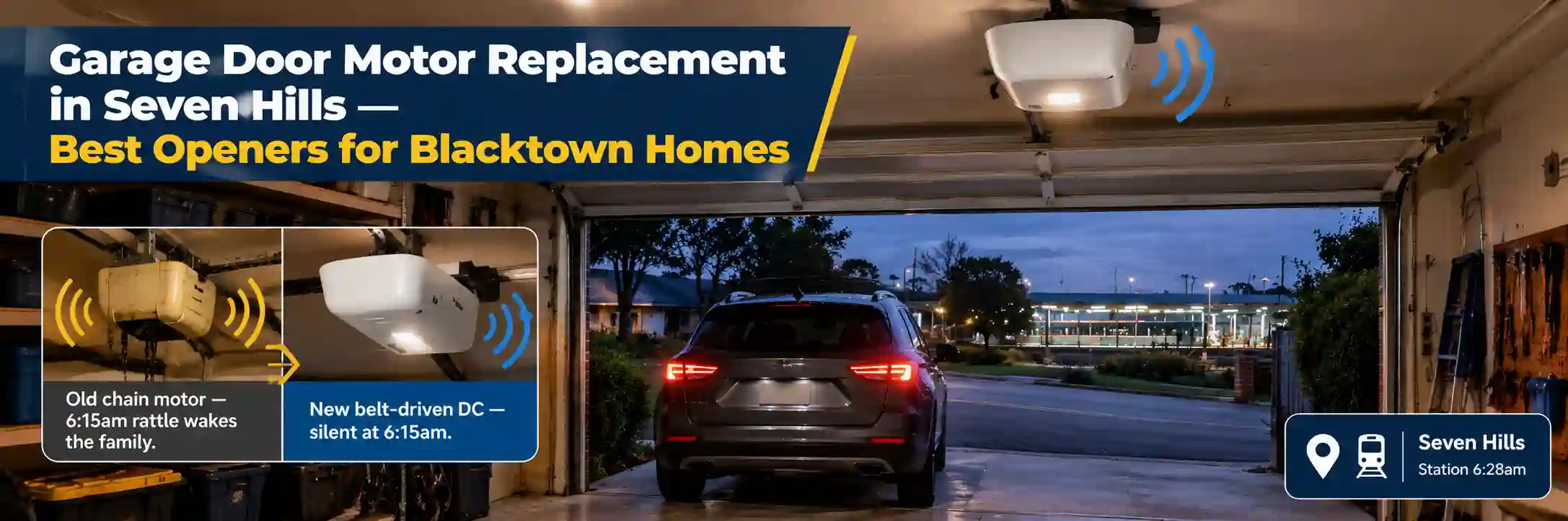
- Belt-driven DC motor for attached garages — the belt-driven DC motor eliminates the chain rattle of the original system and provides the soft-start and soft-stop cycles that reduce impact noise at the beginning and end of each door cycle. For a Seven Hills attached garage adjacent to a bedroom, the noise from the original chain motor at 6am is a household quality-of-life issue that the motor replacement directly addresses. A belt-driven DC motor for a Seven Hills family home with school-age children is the practical investment in the morning household routine.
- Tubular motor for roller doors — for Seven Hills homes with roller doors, a tubular motor inside the drum is the quietest available option and the most humidity-tolerant position for the motor electronics, as the drum housing provides partial shelter from the direct ambient temperature of the hot garage interior.
- IP55+ housing for western Sydney heat and dust — a motor whose housing is rated for IP55 protection is sealed against both western Sydney’s summer dust events and the moisture that Sydney’s rain events introduce. Standard residential motors without IP ratings are adequate for mild Sydney coastal environments but are marginal for western Sydney’s combination of summer heat, dust, and occasional heavy rainfall.
Smart motor features for Seven Hills family households
Garage door motor replacement in Seven Hills for the suburb’s family households — Family Score 10 out of 10, with households managing school runs, sports activities, and work commutes — has specific smart feature value:
- Access log for family management — a Seven Hills household where both parents work and children return from school at different times benefits from the smart motor’s access log that shows when the garage was used and by which remote credential. The parent who checks the app on the train home to confirm that the children have arrived is using the access log for the specific family management purpose that a high-Family-Score suburb like Seven Hills generates in abundance.
- Auto-close timer — a Seven Hills family home where the morning school run involves a rushed departure with the garage sometimes left open benefits from the auto-close timer that closes the door automatically. In a suburb with a Safety Score of 9 out of 10, the security of an auto-closing garage is a meaningful daily assurance for a household that values its suburb’s safety character.
- Battery backup for storm outages — Sydney’s western suburbs experience power outages during severe thunderstorm events more frequently than the inner suburbs. A motor with battery backup allows the garage door to be operated through a power outage — particularly valuable for a Seven Hills family arriving home in a storm who cannot access a car-mounted remote and must enter through the garage.
- Smart home integration — Seven Hills’ professional family demographic includes households already using Google Home or Apple HomeKit for other smart home functions. A garage door motor that integrates with these platforms extends the household’s smart home without requiring a separate app.
Motor replacement for Seven Hills dual occupancy properties
Garage door motor replacement in Seven Hills for dual occupancy properties — the growing stock of granny flat additions and secondary dwelling constructions that Blacktown City Council DA records reflect — involves the same separate automation credential requirement described in the Auburn dual occupancy blog. Each dwelling in a Seven Hills dual occupancy has its own household, and the motor replacement should set up separate rolling-code remote credentials for each dwelling’s garage, ensuring that the security boundary between the two households is maintained at the garage access point. A dual occupancy motor replacement that uses shared remote credentials is one that inadvertently gives each household access to the other’s garage — a security gap that a correctly configured replacement prevents.
The Seven Hills community’s characteristic family household — the working couple with school-age children, the Saturday morning sport run, the after-school activity pickup — creates a specific daily operational rhythm for the garage door motor that is more intense than in suburbs with older demographics or higher proportions of lone person or couple-without-children households. A motor that is operated ten times daily by a Seven Hills family household is being used five times more intensively than the industry standard assumption of two daily cycles, and its service life — both in cycle count and in heat-generated electronic degradation — is proportionally shorter.
The motor replacement technician who understands this specific usage intensity, who recommends a high-cycle rated motor with genuine thermal headroom for a Seven Hills family home where the door is operated all day long, is one who delivers a motor replacement whose service life actually matches the customer’s usage pattern rather than one whose theoretical cycle rating far exceeds what the western Sydney family household’s daily reality will actually deliver.
The Seven Hills T1 Western Line station gives the suburb a commuter dimension that shapes the morning garage door operation timing in specific ways. A Seven Hills household whose adults catch the 6:28am Western Line train to the City departs the garage at 6:15am — the motor operates in the quiet of the early western Sydney morning when sound carries further than during the day’s ambient noise.
A motor replacement that produces a quiet belt-driven or tubular motor operation at 6:15am is one whose daily contribution to the household’s morning routine is felt and appreciated immediately from the first day of operation. For Seven Hills commuter households, the before-and-after comparison between the original chain-driven motor’s early morning rattle and the new belt-driven motor’s silent open is not a subtle difference but an immediately obvious daily improvement that the household values from the first morning departure with the new system.
Conclusion
Garage door motor replacement in Seven Hills converts the suburb’s ageing 25 to 35-year-old chain-driven AC openers into the quiet, smart-connected, IP-rated motors that Blacktown’s family households depend on for reliable daily operation. A belt-driven DC motor for attached garages, an IP55+ housing rating for western Sydney’s heat and dust, smart connectivity for Seven Hills’ active family households, and separate dual occupancy automation credentials for the suburb’s growing secondary dwelling stock — this is the complete motor replacement specification that serves Seven Hills’ western Sydney family character at the standard its community expects.