
Garage door safety in Seven Hills is the topic that matters most in a suburb where the Family Score is 10 out of 10 — a reflection of the high proportion of family households, the density of children under 18, and the active daily life of a western Sydney working family suburb where the garage door is one of the most frequently operated mechanical systems in the home. A garage door is the largest moving object in most Australian family homes — a standard double garage door weighs 60 to 80 kilograms, operates on spring tension that stores significant mechanical energy, and moves along a track path that is in the direct line of pedestrian and vehicle access to the home.
When it works correctly it is invisible infrastructure; when it fails to operate safely, the consequences can be severe. Garage door safety in Seven Hills addresses the specific safety considerations that every Seven Hills homeowner with a family needs to understand — what makes a garage door dangerous, what the legal safety requirements are under NSW law, and what the practical actions are that every family can take to improve their garage door’s safety.
The spring system — the most dangerous component
Garage door safety in Seven Hills begins with understanding that the garage door’s spring system — whether a torsion spring mounted above the door or extension springs mounted on the side tracks in older tilt door systems — stores significant mechanical energy under tension. A torsion spring on a standard residential garage door stores enough energy when wound to cause serious injury if it fails or is improperly released. The specific spring safety points for Seven Hills homeowners:
- Never attempt DIY spring replacement — garage door spring replacement is not a DIY task. The spring is under tension that, when improperly released, can cause the spring to fly from its mounting with significant force. Professional garage door technicians use winding bars, controlled release procedures, and specific safety protocols when working with torsion springs. Attempting to replace a spring without this training and equipment is a serious injury risk.
- Inspect springs annually — a spring that shows visible surface rust, any cracking at the coil sections, or any deformation at the end connections is one that is at elevated failure risk. An annual maintenance visit that includes a spring condition inspection identifies at-risk springs before they fail without warning.
- Never prop a door open when the spring has failed — a garage door with a failed spring does not have the counterbalancing support that allows it to stay in any intermediate position. A door propped open with a stick or other improvised support after a spring failure is not safely supported and can fall unexpectedly.
The safety reversal function — the critical safety mechanism
Garage door safety in Seven Hills: the automatic safety reversal function of the garage door opener is the most important active safety feature in any automated garage door system. Under the Australian Standard AS/NZS 60335.2.95 and the relevant provisions of the Building Code of Australia, all automated garage door systems sold in Australia must have an automatic safety reversal mechanism that reverses the door’s travel when it encounters a resistive force during closing. This mechanism prevents the door from continuing to close when a child, a pet, or any obstruction is in the door’s path.
For Seven Hills homeowners with family households:
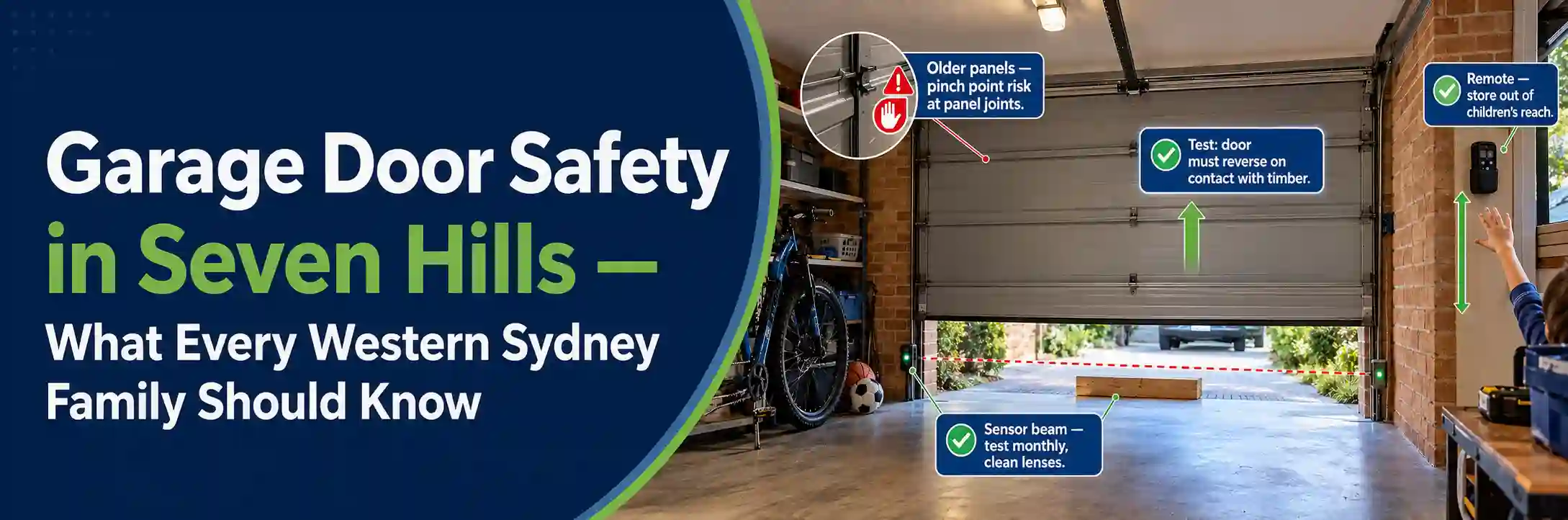
- Test the safety reversal regularly — place a piece of 50mm timber flat on the floor in the centre of the garage opening and operate the door to close. When the door contacts the timber, it should immediately reverse direction. A door that continues to close after contacting the timber has a failed or degraded safety reversal function that must be repaired before the door is used again.
- Test the photo-electric sensor — the photo-electric safety beam that runs across the garage opening near the floor should reverse the door if interrupted while the door is closing. Block the beam with your hand while the door is closing and confirm that the door immediately reverses. A door that continues to close when the sensor beam is interrupted has a sensor fault that needs immediate attention.
- Old openers may not have adequate safety reversal — garage door openers from before approximately 1993 may not have photo-electric sensor systems and may have inadequate safety reversal force sensitivity. A Seven Hills home with an opener that predates 1993 should have it assessed against current safety standards.
Child safety around garage doors in Seven Hills
Garage door safety in Seven Hills for family households: children are at specific risk from garage door systems because they are at the height where the photo-electric sensor beam travels (approximately 15 to 25 centimetres above the floor) and may not understand the danger of being in the door’s path. Practical child safety measures for Seven Hills family homes:
- Keep all remote controls out of children’s reach — a garage door remote control in the hands of a child who does not understand the danger can activate the door unexpectedly. Remote controls should not be left in accessible locations in the home or car, particularly where young children can reach them.
- Teach children the garage door safety rules — children should be taught from an early age never to run under a moving garage door, never to play in the garage doorway when the door is operating, and never to touch the spring hardware, cables, or tracks.
- Check sensor alignment regularly — a photo-electric sensor that has been knocked out of alignment by a bicycle or other item stored in the garage may no longer be projecting the beam correctly across the full opening. Regular visual inspection of both sensor units confirms they are still correctly positioned and that the indicator lights on both units show the beam is uninterrupted and aligned.
The pinch point hazard on older doors
Garage door safety in Seven Hills for the suburb’s older sectional and tilt door systems: older sectional doors without pinch-resistant panel joints have gaps between panels that create pinch point hazards when the door is in motion. A child’s finger placed between panel sections as the door closes can be trapped in the joint between panels as they hinge together during the door’s travel.
Contemporary sectional doors are designed with pinch-resistant panel joints that eliminate or minimise this gap. For Seven Hills homes with older sectional doors whose panels are original to the 1980s or 1990s, the pinch point risk on the panel joints is a specific safety consideration that warrants discussion with a technician about whether the door meets current safety design standards.
NSW legal obligations for garage door safety
Garage door safety in Seven Hills under NSW law: the Australian Consumer Law and the relevant Australian Standards create obligations for garage door products and installations in NSW. Any new garage door and opener installation in Seven Hills must comply with the relevant Australian Standards — including AS/NZS 60335.2.95 for automatic garage door operators — at the time of installation.
A landlord in Seven Hills with a rental property whose garage door is used by tenants has an obligation under the NSW Residential Tenancies Act 2010 to maintain the garage door in a reasonable state of repair, which includes maintaining the safety reversal function and the photo-electric sensor in working order. A landlord whose rental garage door has a failed safety reversal function and whose tenant’s child is injured by the door is in a position of significant legal exposure for the failure to maintain the system’s required safety functions.
The garage door safety conversation in Seven Hills has a specific urgency in the context of the suburb’s high family score and its active household lifestyle. A suburb where the garage is used six to ten times daily by a household with children is one where the statistical probability of an interaction between a child and an improperly functioning garage door system is meaningfully higher than in a low-usage adult household.
The annual maintenance visit that includes a safety reversal test, a sensor alignment check, and a spring condition inspection is not simply a mechanical service — it is the recurring safety audit that confirms the system is protecting the household’s children on the ten-thousandth daily operation with the same reliability it did on the first. For Seven Hills parents who want to be confident that their garage door system is as safe as it should be in a high-usage family home, the annual maintenance visit with explicit safety function testing is the one investment that provides that confidence systematically rather than relying on the hope that a system they have never had professionally assessed is performing correctly.
Conclusion
Garage door safety in Seven Hills is the topic that matters most in a suburb whose Family Score of 10 reflects the high proportion of family households with children who interact with the garage door system daily. The spring system’s stored mechanical energy, the safety reversal function’s role in preventing door-on-person contact, the child safety measures around remote controls and the doorway, the pinch point risk on older sectional door panels, and the NSW legal obligations for garage door safety in residential and rental properties together define the safety knowledge that every Seven Hills homeowner should have and apply.
A garage door system that is correctly installed, correctly maintained, and whose safety reversal function is tested at every annual maintenance visit is the system that operates reliably in Seven Hills’ active family households without becoming the unexpected hazard that a neglected system eventually becomes.